
Oppenheimer’s Princeton Dictatorship Directorship
In 1947, J. Robert Oppenheimer traded the desolate mesas of Los Alamos for the manicured lawns of Princeton, New Jersey, accepting the Directorship of the Institute for Advanced Study (IAS). While historians often view this period as the “golden age” of physics, we review it today for more pragmatic reason: it serves as the ultimate cautionary tale for the modern tech industry. As companies today race to “acquihire” superstar AI researchers with promises of unlimited resources and negligible responsibilities, they are unknowingly replicating an experiment that failed eighty years ago. IAS was built on the hypothesis that money and freedom generate breakthroughs; the result, however, suggests that when you remove the friction of work, you do not get innovation—instead you get internal politics and stagnation.
Structure of the Sanctuary
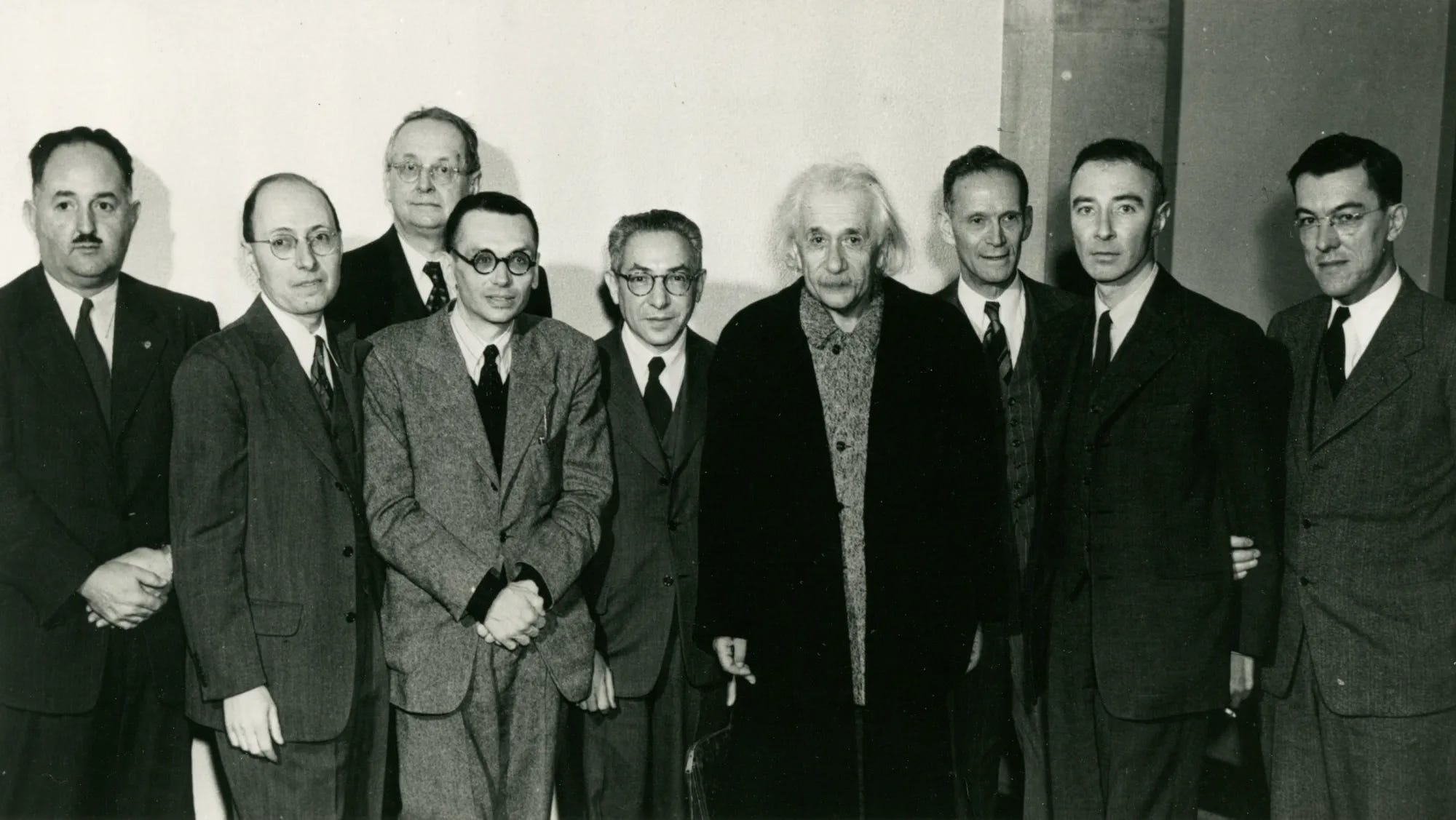
The Institute was a radical experiment in academic structure, designed to be the antithesis of the modern university. It was not a school; it had no students, granted no degrees, and imposed no teaching duties. The format relied on a strict two-tiered caste system: a small cadre of “Permanent Faculty” who held their positions for life, and a larger, rotating group of “Members”—younger scholars invited for one or two years to absorb the atmosphere. Life at the Institute revolved around a singular, almost monastic purpose: the unhurried pursuit of knowledge. The rhythm of the day was dictated not by lecture bells, but by the ritual of afternoon tea in Fuld Hall and long, solitary walks in the surrounding woods. It was a structure built on the utopian belief that if you removed all administrative friction and financial worry from the world’s best minds, breakthrough discoveries would be the inevitable result.
Fallacy of Frictionless Creativity
However, this utopian philosophy—that total freedom equals total creativity—proved to be the Institute’s most significant structural flaw. The history of the IAS serves as a case study for the counter-argument articulated by the filmmaker Orson Welles, who famously noted, “The enemy of art is the absence of limitations.” In the scientific realm, this rebuttal was personified by Richard Feynman.
Feynman, arguably the most creative physicist of the era, famously refused to join the Institute. He argued that the “friction” of teaching—the pressure of students asking basic questions and the administrative grind of a university—was not a hindrance, but a necessity for creative thinking. He stated, “So I find that teaching and the students keep life going, and I would never accept any position in which somebody has invented a happy situation for me where I don't have to teach. Never.” believing that the psychological vacuum of the Institute created a sterile environment where ideas withered from a lack of grounding. This critique was validated by the stagnation of the Institute’s “Old Guard.” Without the external pressures of grant deadlines, teaching loads, or skeptical students, residents like Einstein drifted into esoteric, solitary pursuits that disconnected them from the fast-moving current of physics. The “frictionless” environment did not liberate their minds; it unmoored them.
Asymmetry of Output
Consequently, the productivity at the Institute became deeply asymmetrical. The “Permanent Faculty”—including Einstein and Gödel—often fell into the trap Feynman predicted, viewing the younger generation as a distraction rather than a resource. Einstein, by 1947, was viewed by the younger physicists as a landmark rather than a beacon—a monument to the past who had drifted away from the quantum revolution.
In contrast, the “Young Turks”—the temporary members Oppenheimer brought in—succeeded precisely because they did have friction. They were on short-term contracts, desperate to secure tenure elsewhere, and under the crushing pressure of Oppenheimer’s judgment. This group included Freeman Dyson, who did the heavy lifting of unifying Quantum Electrodynamics (QED), and the duo of Chen-Ning Yang and Tsung-Dao Lee. Their collaboration, which shattered the “sacred cow” of parity conservation (proving nature distinguishes between left and right), earned them the Nobel Prize in 1957. Their success proved that creativity thrives not in a vacuum of comfort, but in the “pressure cooker” of urgent ambition.
Administrative Civil War
While the younger scientists thrived on pressure, the administration thrived on conflict. The Institute was plagued by a toxic administrative culture, most notably the rigid separation of “pure” and “applied” science enforced by Oppenheimer. He viewed the Institute as a monastery for abstract thought, where the blackboard was king and the machine was vulgar. This philosophy created a hostile environment for John von Neumann, who was fighting an administrative insurgency to build his MANIAC computer in the basement. Oppenheimer denied the project adequate resources, viewing it as “engineering” rather than physics. Following von Neumann’s death, Oppenheimer moved quickly to dismantle the project, severing the Institute from the burgeoning digital revolution.
This internal friction was compounded by an external catastrophe: the feud between Oppenheimer and Lewis Strauss, the Chairman of the Board. The animosity crystallized during a 1949 congressional hearing when Oppenheimer publicly humiliated Strauss, comparing his concerns about isotope exports to “a shovel” or “a bottle of beer.” Strauss never forgave the slight. He weaponized the administrative machinery against Oppenheimer, engaging in surveillance and eventually engineering the 1954 security hearing that stripped Oppenheimer of his clearance. For over a year, the Director was focused on legal defense rather than academic vision, leaving the faculty in a state of paranoia.
Modern Parallel
Finally, the IAS experiment stands as a stark warning for the modern tech industry’s obsession with “acquihiring” superstar AI researchers. Just as the Institute believed that removing financial worry would unleash pure creativity, today’s tech giants believe that handing blank checks to “billion-dollar researchers” will accelerate AGI. Instead, history suggests a self-fulfilling prophecy of stagnation.
When you remove the friction of deliverables—shipping code, satisfying customers, or teaching students—you often do not get pure research; you get distraction. Untethered geniuses frequently drift into angel investing, joining boards, and buying boats, doing everything except the work they were expected to do. The lesson from Oppenheimer’s Princeton is clear: true innovation requires the grit of necessity and urgency. When you buy a researcher’s total freedom, you are often paying for their past reputation while ensuring they have no future output.
Skip the Movie, Read the Book
Skip the movie and read American Prometheus by Kai Bird, Martin J. Sherwin to witness the bitter administrative warfare the film omits, particularly the vicious faculty revolts where mathematicians tried to block Oppenheimer from hiring humanists.