
When we talk about the titans of science fiction, the conversation is often dominated by the “Big Three”: Isaac Asimov, Arthur C. Clarke, and Robert A. Heinlein. These authors defined the Golden Age, focusing on grand systems, technological prophecy, and the manifest destiny of man among the stars. Their worlds were often governed by logic, where even the most alien mysteries could eventually be dismantled by the scientific method.
But the Strugatsky brothers’ 1972 masterpiece, Roadside Picnic, occupies a space that is entirely its own. It isn’t just about an alien visitation; it’s about the debris left behind—and the desperate, gritty humanity that tries to survive on the trash of technological gods. It replaces the “manifest destiny” of Western sci-fi with a sense of cosmic insignificance that is as terrifying as it is darkly comedic.
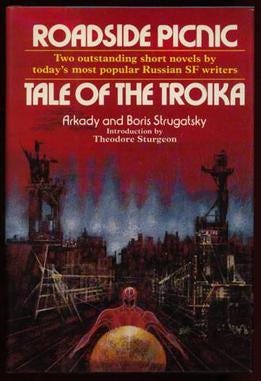
Here is why I think Roadside Picnic remains one of the most unique, biting, and human works in the genre.
Fiction First, Science Second
A common pitfall in science fiction is the sacrifice of “fiction” at the altar of “science.” Many classics prioritize world-building and theoretical physics over prose and character depth. In these works, characters are often mere conduits for explaining how a warp-drive functions or how a galactic empire is structured.
Take Isaac Asimov’s Foundation series. It is a brilliant exercise in “Psychohistory,” but it operates on a grand, detached scale. If you stripped away the galactic stakes and the improbable “mathematics of sociology” and tried to read it as a character study or a piece of literary fiction, it would be nearly unreadable. The prose exists to serve the idea, and the human characters are often chess pieces in a grand historical simulation.
In contrast, Roadside Picnic thrives because of its literary quality and its refusal to explain the unexplainable. Redrick “Red” Schuhart isn’t a scientist or a chosen hero; he’s a “Stalker”—a desperate, foul-mouthed smuggler whose expertise is born of survival, not study. The “science”—the six Zones created by aliens who didn’t even notice humanity—is a background mystery that mocks the human intellect. The focus remains on the psychological toll of living on the edge of radical technological advancement. We feel the weight of Red’s exhaustion, his resentment toward the Institute, and his paternal terror as his daughter begins to transform into a mutant. It is a story about people, not just a delivery system for a “what-if” premise.
The Razor-Sharp Satire of the Soviet Machine
Living behind the Iron Curtain, the Strugatsky brothers were masters of “Aesopian language”—smuggling social critique past censors through the lens of the fantastic. Roadside Picnic is a brutal satire of the Soviet Union’s stagnation, the banality and commoditization of technological danger (perhaps even foreshadowing Chernobyl), and the inevitable corruption of any centralized science authority.
The Bureaucratic Rot: Characterized by figures like Richard Noonan, the book depicts a world where corrupt officials manage brothels and black markets under the guise of “scientific oversight.” The “International Institute of Extraterrestrial Cultures” is less a scientific body and more a playground for petty power-seekers, where prestige is gained not through discovery, but through the successful acquisition of “booty” from the Zone.
Incompetent Authority: We see generals and administrators giving life-or-death orders without a shred of knowledge regarding the actual battlefield within the Zone. They treat the alien artifacts as strategic resources—potential weapons or energy sources—rather than things that have fundamentally broken the laws of physics. Their arrogance lies in the belief that the Zone can be tamed or taxed, ignoring the fact that humanity is essentially playing with discarded cigarette butts that can level cities.
The Drudgery of the Surreal: Perhaps the most “Soviet” element is the casual horror of domestic life. Due to the Zone’s influence, dead relatives return to their homes as “reanimated” husks. In a brilliant satirical nod to Soviet housing shortages and the normalization of the bizarre, families simply adjust. They live with their decomposing, silent ancestors because there’s nowhere else to go. The horror isn’t the presence of the dead; it’s the fact that life continues in its mundane, miserable trajectory despite them. This is done with a mastery that puts even a Solzhenitsyn to shame.
Tarkovsky vs. The Strugatskys / Satire vs. Poem
It is impossible to discuss the book without mentioning Andrei Tarkovsky’s film adaptation, Stalker. However, calling it an “adaptation” is a stretch. Tarkovsky famously stripped away almost every plot point, gadget, and satirical beat from the novel to find what he considered the “metaphysical core.”
Much like how Anton Chekhov famously complained that everyone (including the legendary Stanislavsky) turned The Cherry Orchard into a weeping tragedy when it was meant to be a farce, Tarkovsky took a work of unbelievable humor and turned it into a somber, meditative 161 minute poem (that at times puts audiences to sleep).
The Novel is steeped in the cynical, dark humor of Ilf and Petrov. It is gritty, fast-paced, and deeply skeptical of human institutions. It is a world of “hell slime,” “witch’s jelly,” and black-market deals. The Strugatskys’ Zone is a dangerous physical space where greed and necessity drive men to their deaths. It is a “picnic” where the leftovers are lethal.
The Film is a slow, philosophical exploration of the soul. Tarkovsky removes the humor and the political satire to create a romantic tragedy of an alienated Stalker. He takes two archetypes—the Writer and the Professor—into the Zone to explore faith and religion. While the novel’s Zone is full of physical traps, Tarkovsky’s Zone is a psychological mirror that reflects the emptiness of the seekers.
While the movie is a cinematic landmark, it loses the “Roadside” element—the devastating, ego-bruising idea that humanity is just a primitive ant colony living near a highway where technological gods stopped for a snack and threw their trash out the window. The film elevates the Stalker to a priest-like figure, whereas the book leaves him as a man just trying to pay his bills while juggling a mutant “monkey” daughter, a zombie father, and a train-wreck relationship.
The “Golden Ball” of Ideology
When Red Schuhart finally reaches the “Golden Ball”—the legendary alien artifact that supposedly grants the heart’s deepest desire—he discovers the ultimate punchline: he is a man with no heart left to speak of. After decades spent dodging alien death-traps and navigating the suffocating rot of the Soviet machine, Red realizes his imagination has been thoroughly lobotomized.
When the moment of ultimate power finally arrives, he finds his internal dictionary is empty. He has no personal dreams, no revolutionary vision, and no vocabulary for salvation that hasn’t been pre-processed and stamped by the State. He is a man standing before a god-like technology with the creative range of a career bureaucrat.
In a moment of peak absurdity, the only “prayer” Red can muster is a piece of stolen, recycled propaganda. He screams the same communist platitude used by the innocent boy he just sacrificed to reach the prize: “Happiness for everybody, free, and may no one be left behind!”
This is the Strugatskys’ final, sardonic joke: the technology is alien, but the failure of imagination is entirely homegrown. Red is so hollowed out by the collectivist ideology of his upbringing that even when handed the keys to the universe, he can only regurgitate a slogan from a May Day parade. This marriage of cosmic indifference and the utter bankruptcy of human ideology—the joke that we wouldn’t know what to do with a miracle if it hit us in the face—is what makes Roadside Picnic a singular masterpiece of dark, satirical “science” fiction.
Dedication
Dedicated to my dear friend Wayne E. Yang, a science fiction buff with encyclopedic knowledge, who is courageously pursuing writing as a second act and who always encouraged me to write.
Nice. Your Asimov vs. Strugatsky comparison is the perfect way to frame the idea vs. Individual debate. By keeping the science indifferent, the literal picnic trash of the cosmos, the authors force us to stay in the mud with Red Schuhart. It’s that refusal to grant the reader (or the characters) the dignity of being 'special' to the universe that makes the story so biting. It’s not a story about technology; it’s a story about the exhaustion of living in its wake. Brilliant analysis! Thank you 🙏