
I would like to publicize (or said more accurately in french, “vulgariser”) the work of William Kentridge, one of my favorite artists, but I find it very difficult to say something succinct about the meaning, motivation, and influences of his work. He tried to explain his work in a series of lectures, but I’m not sure even he entirely succeeded.
So instead of approaching this from an art historical viewpoint, we will approach it factually and as a personal survey of some of his most inspiring work.
Here are some basic facts to know about William Kentridge:
Born: 1955 in Johannesburg, South Africa
Parents: Sydney and Felicia Kentridge, prominent anti-apartheid lawyers
Lives in: Johannesburg, South Africa
Works in the following mediums: Charcoal drawing, animation, kinetic sculpture, tapestry, and performance
Has exhibited at: The Museum of Modern Art (New York), the Louvre (Paris), the Whitechapel Gallery (London), and the Venice Biennale
Opera productions include: The Magic Flute, The Nose, and Wozzeck
Becoming an Artist
He often recounts a pivotal moment of self-definition that arose not from success, but from a lack of alternatives. After leaving academic programs in politics and fine art, and studying mime in Paris (where he decided he would never make it as an actor), he found himself back in Johannesburg, essentially “messing around” in a studio. It was only when filling out a travel document, faced with the blank field for “profession,” that he tentatively wrote “artist”—simply because he had nothing else to put.
When you consider the sheer scale of his subsequent output—the diversity of his mediums, the rigor of his studio practice, and the philosophical depth of his inquiry—you realize how weighty that title actually is, and how casually it is tossed around in our current era of “content creation.”
A Bit of Art History, Family Influences
It is impossible to separate the artist from the lineage of law and justice he was born into. His father, Sir Sydney Kentridge (now 103), famously represented Nelson Mandela and the family of Steve Biko, while his mother, Felicia, co-founded the Legal Resources Centre to challenge apartheid’s systemic injustices.
The seminal breach occurred when six-year-old William wandered into his father’s study and opened a yellow Kodak box, expecting chocolates. Instead, he found evidentiary photographs of the Sharpeville Massacre—images of unarmed protesters shot in the back. This trauma provided an aesthetic foundation for his career, teaching him that the polite veneer of bourgeois life—the desk, the suit, the yellow box—was merely a container for horror.
Making Films Through Charcoal
William Kentridge is prolific in dozens of art forms, exhibiting a level of experimentation comparable to a Picasso or a Duchamp. Yet, despite this vast range, the medium he keeps coming back to is charcoal. Instead of using computer software or thousands of celluloid sheets, he commits himself to a single sheet of paper and a piece of charcoal. He calls this approach "stone-age filmmaking."
The process is a ritual of endurance: he draws, walks across the studio to the camera, captures a frame, walks back, erases, redraws, and repeats. The crucial element is the fallibility of the erasure. Charcoal, once applied to heavy paper, is difficult to remove completely. Every time Kentridge alters a scene—changing a crowd into a landscape, or a dead body into a pile of rubble—a grey smudge remains. These “ghosts” track the passage of time and the imperfect nature of memory.
The Arc of the Procession
A central image in Kentridge’s visual language is the procession—a long, ragged line of figures moving across the landscape. Unlike a military parade or a Roman triumph, which celebrates victory, order, and power, Kentridge’s processions are of the dispossessed. They are refugees, porters, and the anonymous crowds of history carrying their burdens. He explicitly cites the dark, chaotic processions in Francisco Goya’s Black Paintings as a key influence—specifically works like Pilgrimage to the Fountain of San Isidro—where the movement is not one of glory, but of collective suffering, fanaticism, and chaotic humanity.
Accompanying this procession is often a mechanical elephant. Constructed from industrial debris—including cams, levers, bicycle wheels, and jerry cans—the sculpture makes no attempt to hide its mechanics. Its trunk is typically fashioned from a megaphone. When active, the machine moves with a heavy, disjointed gait rather than a smooth glide. The visible strain of the mechanism against gravity perhaps serves as a literal representation of the “heavy load” of history.
Orchestrations For the Eyes
When directing opera productions for venues like the Metropolitan Opera and Salzburg Festival, Kentridge utilizes complex stage designs characterized by high-density visual information. The sets typically feature multiple layers of projections, moving mechanical elements, and light effects that operate simultaneously with the performance.
In his production of Mozart’s The Magic Flute (excerpt here), the staging incorporates imagery related to early photography and Victorian eras. The backdrop features animated projections that shift throughout the opera, changing the apparent depth and structure of the stage in synchronization with the musical score.
For Shostakovich’s The Nose (excerpt here), the set design utilizes the visual style of 1920s Russian Futurism and Constructivism. The stage features jagged geometric shapes, industrial typography, and bold colors. The singers perform amidst large-scale animations and scrolling images of newspapers that often dominate the visual field, creating a crowded environment where the human figures appear small against the moving backdrop.
This visual density creates a kind of sensory overload—an almost epileptic fit of images that perfectly matches the complexity of the operatic scores. The layering of animation, projection, and performance mirrors the intricate layering of the music itself.
How Kentridge Can Change Your Life
I first encountered Mr. Kentridge’s work at an San Francisco Museum of Modern Art exhibition. Stepping into a darkened room, I was confronted by a miniature theater box performing The Magic Flute, complete with moving puppets and shifting projected geometries. That single encounter played a pivotal role in my decision to move to San Francisco—far more than the allure of prospecting for Silicon Valley gold. I was so mesmerized by the world he had created, and by an institution that would champion it, that I felt a sudden, magnetic pull to the city.
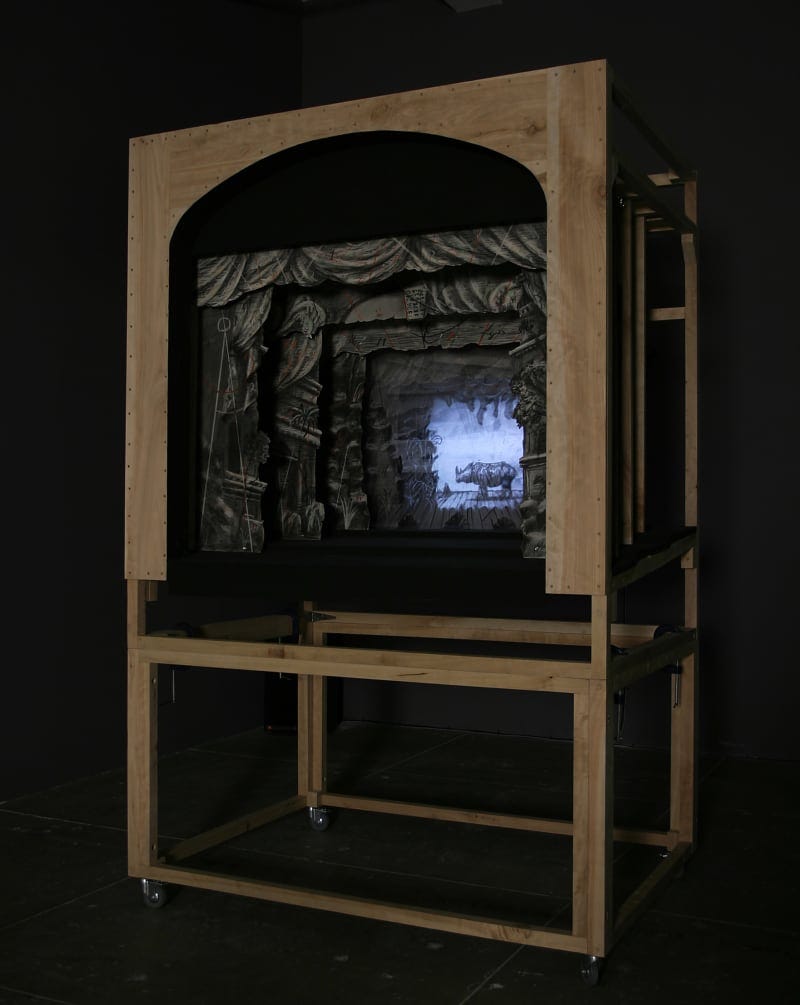
So as Mr. Kentridge would probably prefer, let us avoid ascribing labels to the meaning or style of his work; instead, we simply acknowledge the transformational power of encountering it personally.