
The Russian Revolution of 1917 dismantled imperial structures and demanded a radical restructuring of cultural life. Art was no longer viewed as a luxury for the elite but as a functional tool for education and mass mobilization. While this shift transformed visual art through Constructivism and reshaped poetry into a rhythmic weapon for the masses, the most profound structural and aesthetic changes occurred within the theater. Playwrights, directors, and designers rejected bourgeois realism in favor of experimental forms that mirrored the industrial energy of the new state. This movement fundamentally altered the mechanics of performance, the architecture of the stage, and the relationship between the actor and the audience.
Contextual Shifts in Visual Art and Poetry
Before focusing on the stage, it is necessary to note how the revolutionary ethos permeated other mediums. In the visual arts, painters abandoned representation for Suprematism and Constructivism. Artists like Kazimir Malevich and El Lissitzky used geometric abstraction to create a universal visual language, while others designed propaganda posters for the Russian Telegraph Agency. In literature, Vladimir Mayakovsky spearheaded the Futurist movement, stripping poetry of academic ornamentation. He utilized staccato rhythms, street slang, and declamatory language designed to be shouted to crowds in public squares rather than read silently in private salons. This broader artistic rebellion provided the exact ideological and aesthetic framework that theater practitioners adopted to revolutionize the stage.
Literary and Directorial Innovations: Mayakovsky, Meyerhold, and Gorky
The intersection of revolutionary politics and theatrical form is best exemplified by the work of Vladimir Mayakovsky, Vsevolod Meyerhold, and Maxim Gorky. Gorky provided the transition from imperial realism to socialist critique. His pre revolutionary play The Lower Depths had already shifted focus toward the marginalized proletariat, but his post revolutionary work aligned more directly with the state’s educational objectives, capturing the psychological reality of class struggle.
Mayakovsky brought the aggressive energy of Futurism directly into the playhouse. His 1918 work Mystery-Bouffe was a satirical piece that recast the biblical story of the flood as a triumph of the unclean workers over the clean bourgeoisie. It was a massive spectacle that shattered traditional narrative structures.
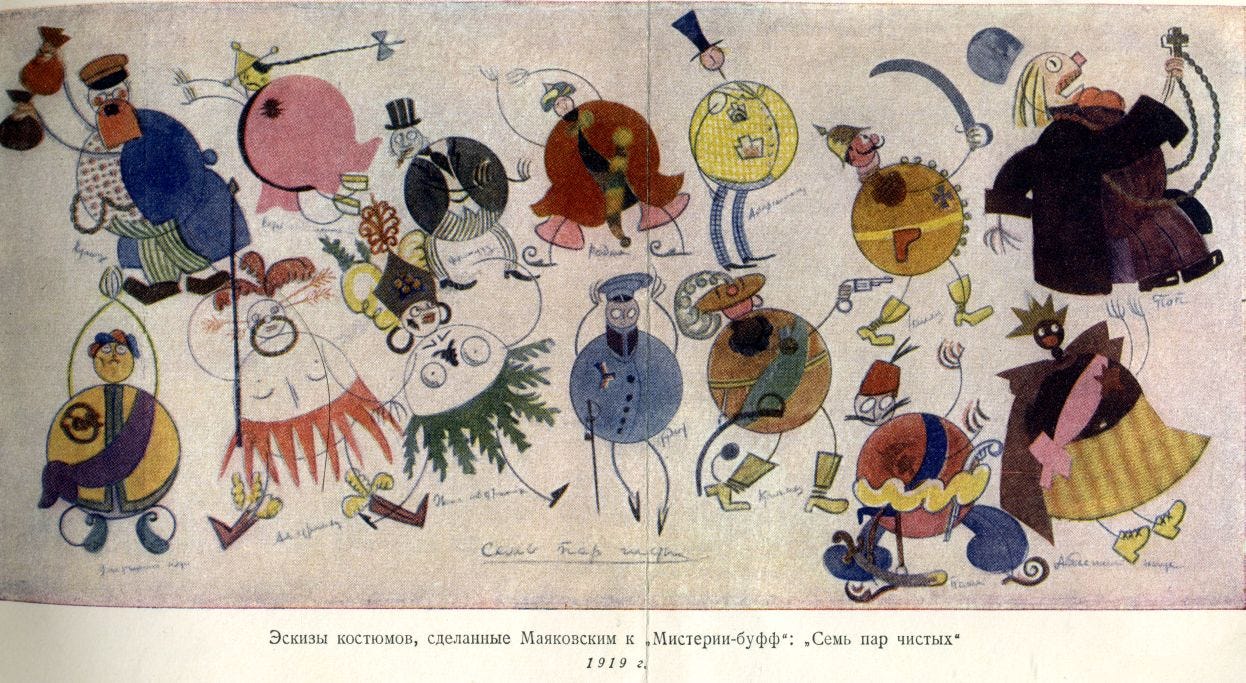
Vsevolod Meyerhold transformed these texts into physical reality. He completely broke away from the psychological realism of his former mentor, Konstantin Stanislavski. Meyerhold viewed the actor as a worker in a factory, developing a training system called Biomechanics. This system treated the human body as a mechanical instrument, emphasizing acrobatics, precise physical control, and rhythmic movement to convey emotion and ideological purpose without relying on internal psychological reflection.
Transformation of Theatrical Companies
The organizational structure of theatrical companies changed as drastically as the acting styles. Prior to the revolution, theater was dominated by state subsidized imperial venues or private, bourgeois institutions like the Moscow Art Theater, which catered to affluent patrons. Following 1917, these companies were nationalized under the Theater Department of the Commissariat of Enlightenment, headed by Anatoly Lunacharsky.
New types of companies emerged to democratize the art form. The most distinct were the mass spectacles and the agitprop theaters. Companies like the Theater of Revolutionary Satire traveled directly to factories, military barracks, and public squares. These groups were agile, low budget, and collective. Unlike traditional companies that maintained a strict hierarchy of directors, star actors, and stagehands, revolutionary troupes operated on egalitarian principles. Performances were often interactive, casting the audience not as passive observers but as active participants in a shared political ritual.
Structural Innovations in Stage Design
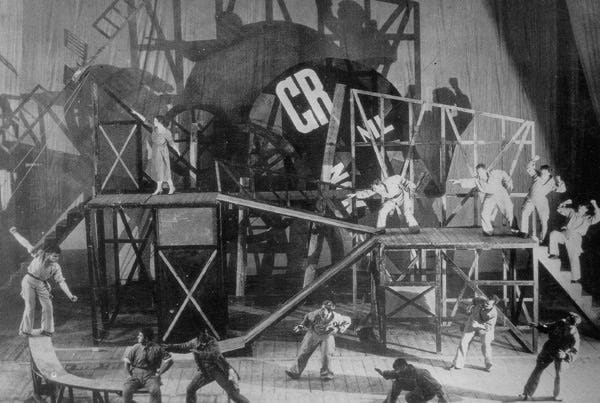
Revolutionary theater required an entirely new visual language, leading to the birth of Constructivist stage design. Scenographers like Lyubov Popova and Varvara Stepanova rejected painted backdrops, illusionistic lighting, and decorative curtains, viewing them as bourgeois deceptions.
Instead, they treated the stage as an explicit construction site or a factory floor. For Meyerhold’s 1922 production of The Magnanimous Cuckold, Popova designed a multi tiered skeletal framework consisting of scaffolding, ladders, moving wheels, and revolving platforms. The set did not represent a specific geographic location; it functioned as an apparatus for the actors to demonstrate their physical prowess. Costumes were replaced by functional blue collar work uniforms known as protopodezhda, designed to allow maximum freedom of movement while erasing class distinctions on stage.
Contemporary Endurance of Revolutionary Techniques
The artistic innovations pioneered during the Russian Revolution continue to shape the mechanics of contemporary performance. Meyerhold’s concept of Biomechanics remains a foundational pedagogy in physical theater training programs worldwide, influencing avant garde directors who prioritize physicality over text based realism.
The practice of environmental theater, which removes performances from traditional proscenium arch auditoriums and places them in found spaces, warehouses, or public streets, derives directly from early Soviet agitprop and mass spectacles. Furthermore, the minimalist, industrial aesthetic characteristic of modern stage design, which frequently utilizes exposed scaffolding and utilitarian materials, traces its lineage directly to Constructivist scenography.
While these artists believed they were building a permanent aesthetic infrastructure for a utopian future, history took a different turn as the soviet regime eventually suppressed these very avant garde movements in favor of rigid socialist realism.