
Alain Resnais’ 1980 film Mon oncle d’Amérique (My American Uncle) is a cinematic laboratory that tests the biological theories of Dr. Henri Laborit. The film follows the lives of three different people to show how human behavior stems from survival instincts rather than conscious choice. Resnais adopts a slow, meticulous pace that allows the viewer to observe these lives as if through a microscope. Central to this experience is the velvet voice of Laborit himself, acting as a guide who leads the audience through the complexities of the human brain.
Although the film’s title suggests a mythic escape, the film argues that human destiny is shaped by evolutionary wiring. This realization is devastating because it strips away the illusion of free will, suggesting that our most profound tragedies and triumphs are merely the results of biochemical reactions to environmental stress.
Philosophy through Narrative
The structure of the film is its most radical feature. The narrative is frequently interrupted by Dr. Henri Laborit, who speaks directly to the camera about behavioral psychology and the three brains theory. This format mirrors the style of Basni Krylova, where a specific anecdote is used to demonstrate a universal moral or truth. In this case, the moral is biological. The characters are like the animals in a fable, acting out patterns of dominance, submission, and flight. Resnais uses these interlaced stories to show that what we call personality or destiny is often just a reaction to environmental stimuli and chemical signals.
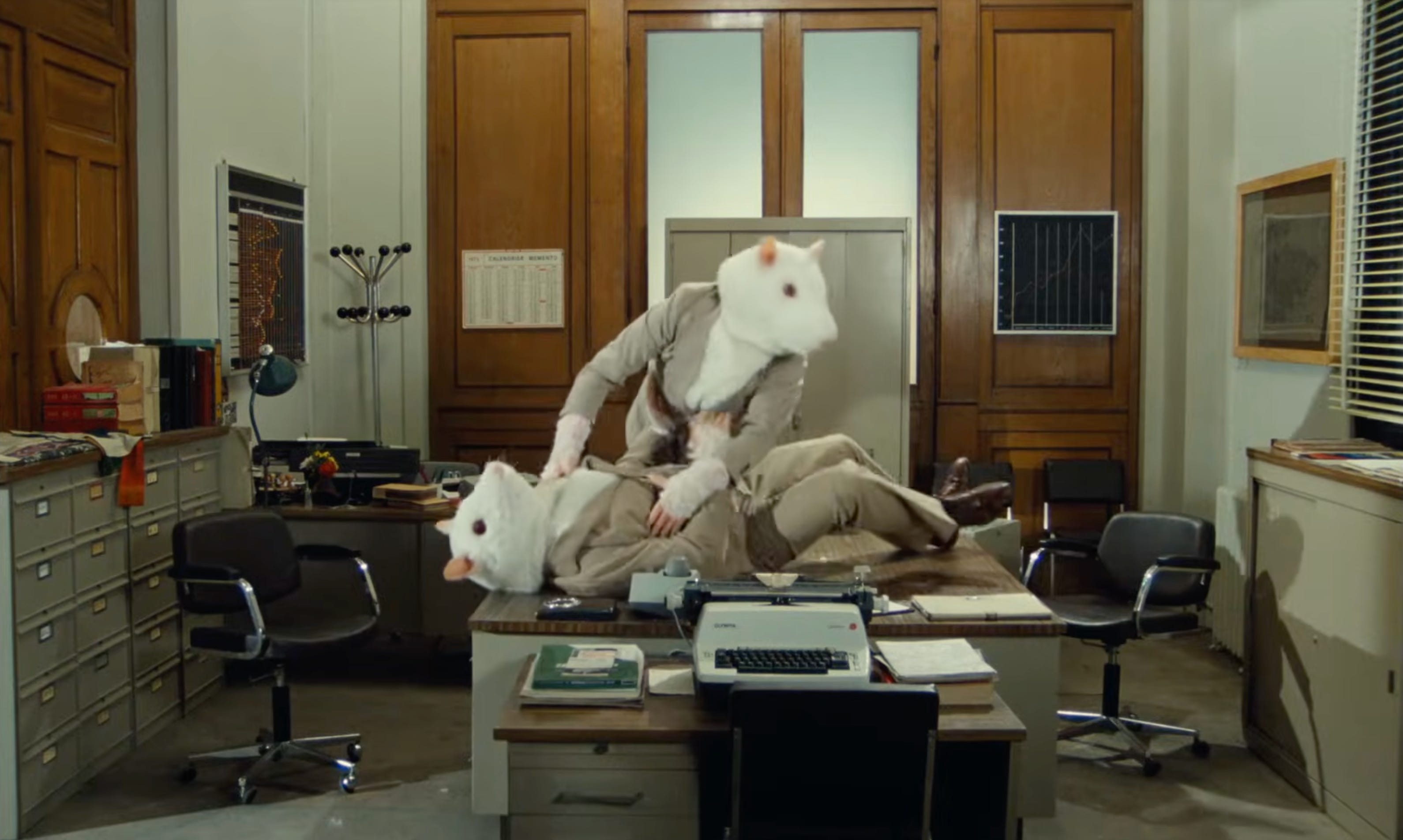
It is a cinematic experience like no other because there is no need to wonder what is happening. Whether a character is depressed or sexually frustrated, Laborit explains the underlying cause. Normally this approach would feel pedantic and overbearing, but Resnais avoids this trap. There is humor and feeling in the translation of these theories. This is most evident when the characters physically inhabit their biological roles, wearing giant rat heads to demonstrate Laborit’s laboratory experiments within the context of their human lives. These visual metaphors prevent the film from becoming a dry lecture and instead turn it into a surreal, darkly comic study of human nature.
Depardieu and Arditi: Career Defining Roles
The film features Gérard Depardieu and Pierre Arditi at the peak of their craft, though in very different registers. Depardieu plays René, a factory manager whose physical bulk hides a fragile internal state. His performance captures the slow disintegration of a man unable to adapt to corporate pressure. René is a decent and loyal family man, which makes his eventual suicide attempt unbelievably painful to watch. There is a specific cruelty in seeing a character who has followed all the rules of social and familial loyalty find himself completely abandoned by his own biology.
Conversely, Pierre Arditi plays Zambeaux, a character who is a genuine asshole. At this stage in his career, Arditi’s portrayal is sharp and unlikable, lacking the warmth he would later become famous for. This role served as the blueprint for his future career. Over the following decades, Arditi would refine this archetype, adding a layer of charm and wit to become the French stage’s most beloved rascal (at least to me).
The Meaning of the Title
The “American Uncle” of the title is a recurring French cultural trope representing a wealthy, long lost relative who will one day return from America to solve all of one’s financial and personal problems. It is a myth of salvation from afar. For the characters in the film, the Uncle is the illusion that a better life is just one windfall or one change of scenery away. Resnais uses this title ironically. The film demonstrates that there is no magical rescue coming from the outside. Because our behavior is governed by biological imperatives, moving to America or inheriting a fortune would not change the fundamental ways we respond to stress or competition.
Influences and Context
Alain Resnais was a key figure of the Left Bank filmmakers, a group often associated with the French New Wave but more focused on literature and the mechanics of memory. His work is defined by an obsession with how the past and the subconscious dictate the present. This is evident in his earlier masterpieces like Hiroshima mon amour and Last Year at Marienbad. While those films dealt with the subjective nature of time, My American Uncle shifts the focus to the objective nature of biology. Resnais was deeply influenced by the surrealists and the Nouveau Roman (New Novel) writers. Authors like Alain Robbe Grillet and Marguerite Duras rejected traditional linear plots and psychological portraits. Like them, Resnais used fragmented structures to challenge the viewer’s perception of reality.
Conclusion
Mon oncle d’Amérique is a cold film that rejects romantic ideas. Resnais shows that we do not lead our lives; our synapses lead us. The “American Uncle” is a lie we tell ourselves in politics, books, philosophy and even cinema. It is a promise of a rescue that never comes because it ignores the facts of evolution.
The film is a landmark of cinema because Resnais successfully integrated pure science into the narrative form. Resnais demonstrates that the most terrifying thing in cinema is not a ghost or a serial killer, but the objective truth of our own evolutionary biology.