
If there are brief glimpses of heaven on earth in places like Patagonia or Yosemite, they can also be found in manmade form within the Marly Court at the Louvre. The glass roof designed by I.M. Pei, the specific quality of light reflecting off the stone, and the arrangement of white marble sculptures provide an appreciation for proportion, material, and the interplay of empty and occupied space. This setting addresses the fundamental questions that architecture and art encourage us to consider.
The monumental marble horses and mythological figures that fill the glass roofed Cour Marly are the survivors of a royal estate that no longer exists. While the Château de Marly was destroyed in the early nineteenth century, its decorative program remains one of the most significant collections of eighteenth century art.
These sculptures were designed to convey a message of mastery over the natural world, specifically through the depiction of the struggle between human willpower and the raw energy of nature. The works were relocated to the museum to prevent further decay from exposure to the elements and to provide a permanent home for the fragments of a vanished palace.


The Purpose of Marly
Louis XIV commissioned the Château de Marly in 1679 because he wanted a residence where he could escape the rigid etiquette of the court at Versailles. The architectural layout was unique because it consisted of a central royal pavilion surrounded by twelve smaller pavilions intended for guests. Marly was a landscaped estate where the gardens and water features were the primary focus rather than the size of the building itself. Access to the grounds was a sign of high social status because guests could only visit if they received a personal invitation from the King.
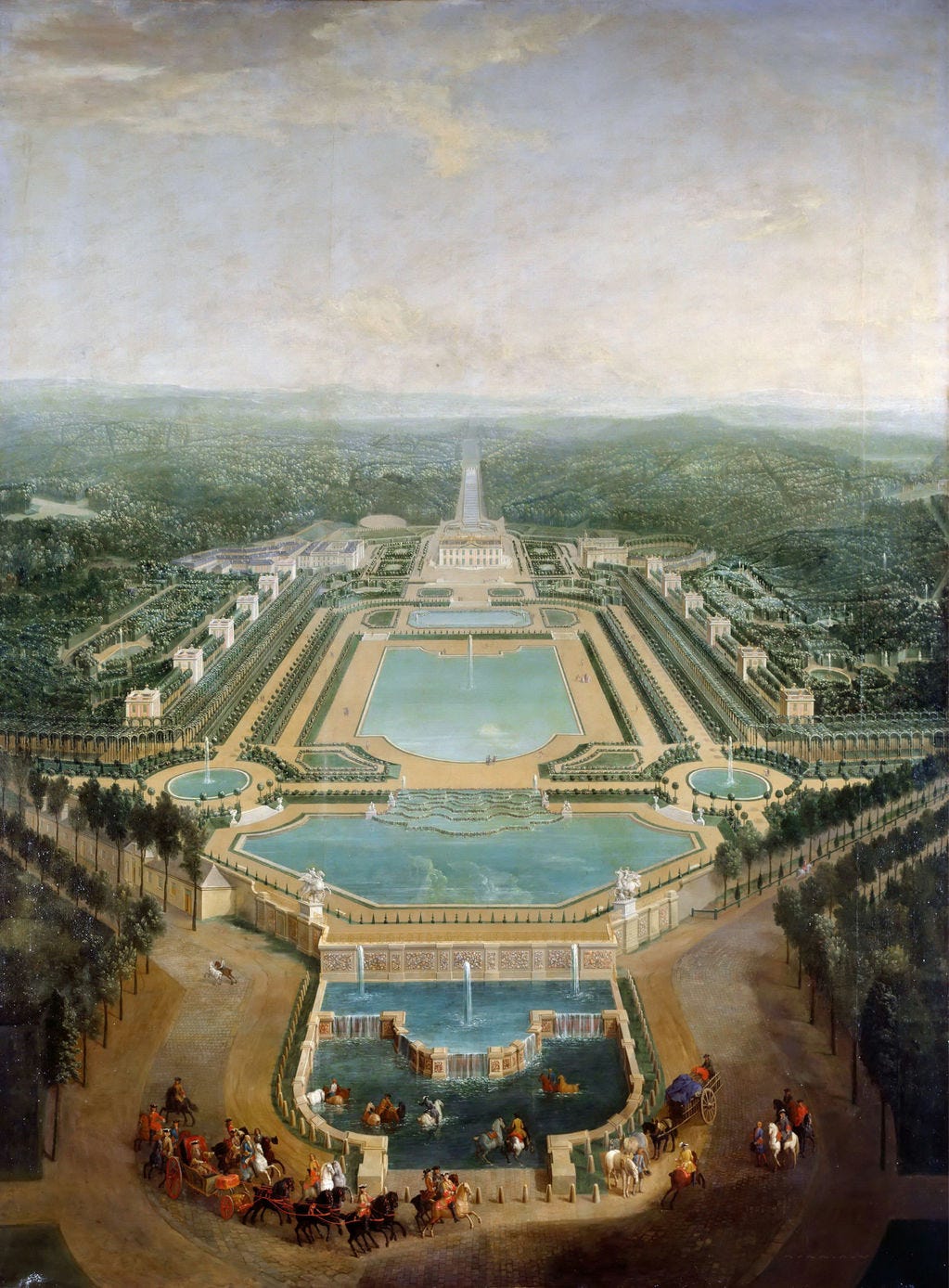
Marble Masterpieces
The gardens of Marly were populated with high quality sculptures that celebrated the King’s power through classical mythology. Antoine Coysevox completed the two winged horses, Mercury and Fame, in 1702 to stand at the upper part of a large watering pond called the Abreuvoir. Decades later, Louis XV decided to move these original statues to the Tuileries Gardens in Paris. To fill the empty spots at Marly, he commissioned Guillaume Coustou to create two new sculptures. Coustou produced the Marly Horses between 1739 and 1745, which depicted grooms struggling to tame wild stallions without the use of harnesses or saddles.
While the “Marly Horses” are the most famous, the collection in the Cour Marly is quite extensive. Here are the primary works:
The Marly Horses (Chevaux de Marly): Two marble groups by Guillaume Coustou showing grooms taming wild stallions, originally placed at the Abreuvoir.
Mercury on Pegasus: A winged horse sculpture by Antoine Coysevox, originally at the entrance to the park.
Fame on Pegasus (La Renommée): The companion piece to Mercury by Antoine Coysevox, showing the figure of Fame blowing a trumpet.
Neptune: A large marble statue by Charles-Antoine Coypel and later Antoine Coysevox, representing the god of the sea.
Amphitrite: The companion to Neptune, also by Antoine Coysevox.
The Seine and the Marne: Allegorical river figures by Nicolas Coustou that decorated the park’s water features.
The Loire and the Loiret: Another pair of river allegories by Cornu and Regnaudin.
Pan: A sculpture by David Bourderelle representing the god of the wild.
Flora and Zephyr: A delicate group by Antoine Coysevox representing spring and the wind.
Air and Water: Part of a series of the four elements that populated the groves of the garden.
Destruction of the Estate
The decline of Marly began during the French Revolution when the furniture was sold and the buildings were neglected by the state. In 1799, the estate was sold for the bargain price of 500,000 francs (approximately 5M-7.5M euros today) to a business partnership led by Alexandre Sagniel, an industrialist who lived at the prestigious No. 6 Place Vendôme in Paris. Sagniel collaborated with a wood merchant named Jean-David Coste to acquire the grounds. While Sagniel installed cotton spinning machinery in the service buildings, his business model was essentially parasitic.
Even before the factory officially failed in 1806, Sagniel began to treat the palace as a source of raw materials. He stripped the massive lead roofs from the pavilions and dug up the complex network of lead pipes that fed the garden fountains to sell the metal on the scrap market. This stripped the buildings of their waterproofing, leading to rapid structural rot. When the industrial venture finally collapsed, Sagniel systematically sold off the stones of the pavilions as building blocks for local villas. By 1816, the main buildings were completely gone and the terrain was leveled. The sculptures survived because they were recognized as national treasures and moved to public spaces in Paris, such as the Place de la Concorde.
Transition to the Louvre
For nearly two centuries, the original Marly sculptures remained outdoors where they suffered from erosion and urban pollution. In 1984, the French government decided to move the original Marly Horses to the Louvre for permanent protection, replacing them with concrete copies in the city. The architect I.M. Pei designed the Cour Marly as part of the Grand Louvre project in the 1990s. This glass roofed courtyard allows the statues to be viewed in natural light while keeping them in a climate controlled environment that prevents further chemical weathering of the marble.
Modern Preservation and Virtual History
The survival of the Marly sculptures provides a physical link to a palace that can now only be seen in paintings and engravings. Today, the site at Marly le Roi is a quiet park where visitors can walk through the empty footprints of the former pavilions. Ironically, the greed of Alexandre Sagniel created a historical vacuum that allowed for something far more profound than a simple reconstruction. By clearing the site of its physical structures, he inadvertently ensured that the sculptures would eventually be gathered into a space that transcends their original purpose.
The architectural achievement of I.M. Pei in the Louvre surpasses the grandeur of the lost royal gardens by fundamentally recontextualizing the art. The space has transitioned from a lavish, terrestrial garden designed to display royal power and exclusionary style into an ethereal environment of spiritual uplifting and contemplation of true beauty.