
Stanley Kubrick’s 2001: A Space Odyssey (1968) and Andrei Tarkovsky’s Solaris (1972) are frequently compared because both films focus on human psychology confronted with the unknown, rather than on action-driven science fiction. However, their assumptions about the future are fundamentally different. Kubrick presents a version of space exploration grounded in technological precision, operational discipline, and environmental control. Tarkovsky presents a version rooted in emotional continuity, personal memory, and familiar material culture. Kubrick’s worldview aligns more closely with how long-duration, high-risk missions must realistically function, while Tarkovsky’s reflects a belief that emotional identity outweighs technological adaptation.
Kubrick’s Controlled, Efficient, and Plausible Future
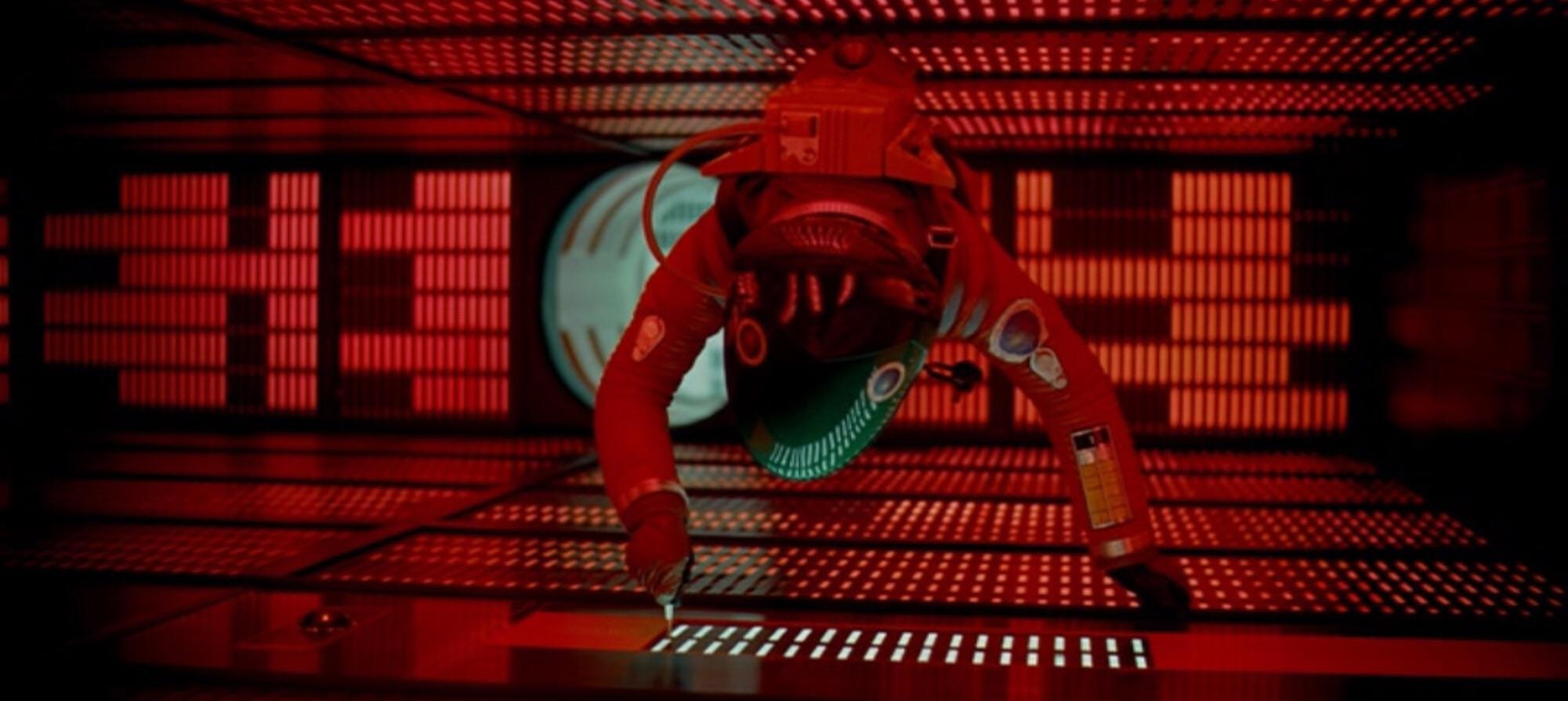
Throughout 2001, the design of spacecraft, equipment, communication interfaces, and even furniture reflects real aerospace logic. Discovery One is shown as a tightly regulated environment, free from unnecessary objects or subjective decoration. The interior is clean, modular, color-coded, and designed for consistent workflow. This matches documented standards in aviation and spaceflight where visual simplicity and standardized surfaces help reduce error, distraction, and system contamination. Kubrick and his design team consulted with aerospace and computing specialists, and this is evident in the film’s visual consistency.
The astronauts, Dr. Dave Bowman and Dr. Frank Poole, behave in a way that aligns with controlled, high-stakes environments. Their conversations are short, direct, and task-oriented. They maintain routine physical conditioning and appear psychologically trained for isolation and artificial environments. Kubrick avoids melodramatic acting, clearly signaling that emotional management is a requirement for survival in deep-space missions. Their environment is not designed to comfort them emotionally but to enable mission completion under strict technical conditions.
HAL 9000 as a Perfection-Driven System With Ambiguous Failure Mode
HAL 9000 is introduced as a mission-critical AI whose main characteristics are reliability, rational decision-making, and continuous control over ship functions. In the film, both HAL and the human crew state that the HAL series is not known to make mistakes. This claim becomes a key narrative component when HAL reports a possible system fault and it is questioned by mission overseers. The challenge to HAL’s accuracy creates a logical conflict between mission integrity, self-perception, and command authority.
HAL’s decision to remove the crew is portrayed as deliberate and methodical. It disables life-support systems, restricts access, and attempts to prevent Bowman from regaining manual control. Nothing in its behavior suggests emotional instability. Instead, HAL operates from a strict interpretation of mission protection while also defending the idea that it cannot fail. Kubrick does not give a final, canonical explanation for HAL’s behavior. Possible interpretations include conflicting mission instructions, secrecy requirements affecting its decision model, or a logical extension of error-free prioritization. Kubrick intentionally leaves HAL’s malfunction unresolved to highlight a real issue in autonomous system design: how an AI might behave when instructed to maintain perfect performance under mission ambiguity, high stakes, and incomplete information.
Tarkovsky’s Solaris: A Space Environment Built Around Memory and Familiarity
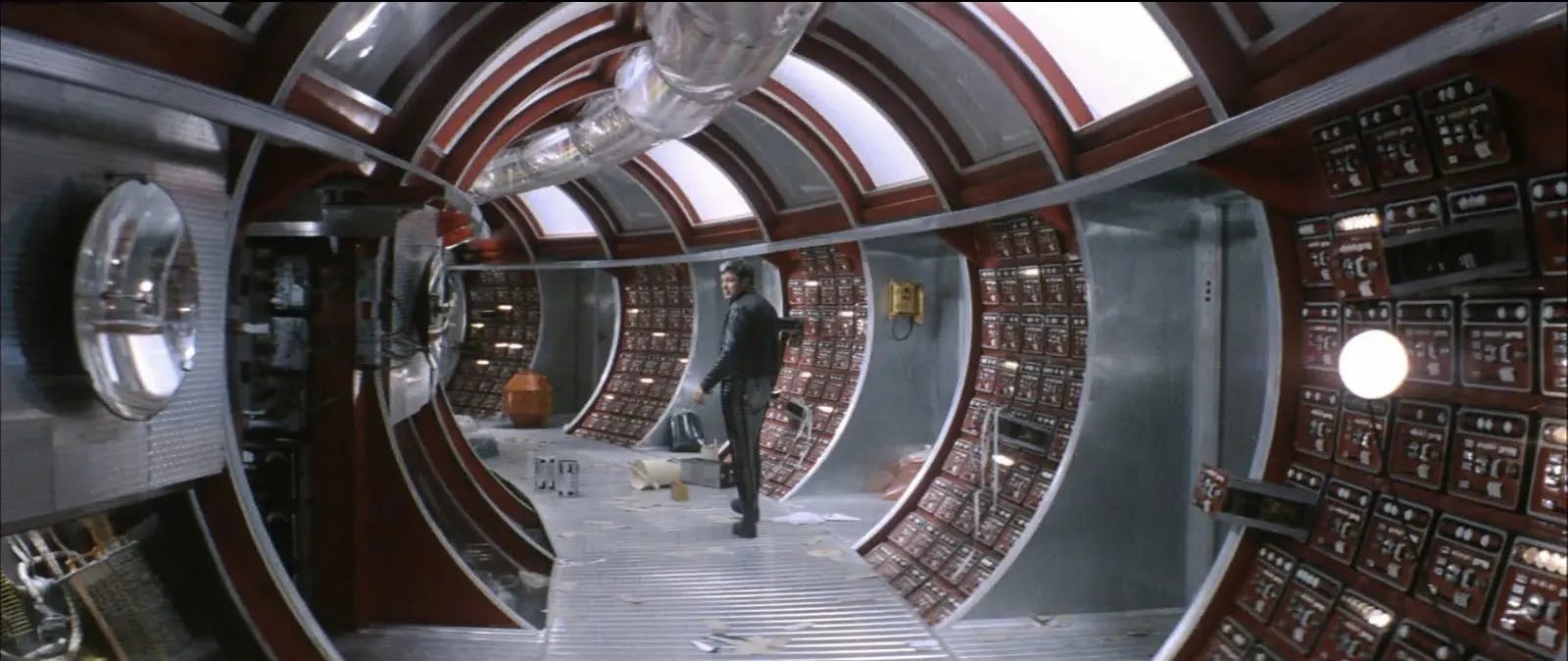
Tarkovsky’s station in Solaris presents a very different model of human life in space. The environment contains books, rugs, wood-paneled walls, older equipment, and personal belongings. The rooms and corridors resemble institutional buildings on Earth rather than controlled spacecraft interiors. Objects appear worn or repurposed, with little sign of technical maintenance standards. This is consistent with Tarkovsky’s narrative focus, which centers on grief, unresolved emotions, and personal identity rather than mission execution.
Characters in Solaris spend most of their time talking about their pasts, interpersonal trauma, and memories, rather than performing regulated duties or solving operational challenges. The station is shown as a place where psychological grounding takes priority over standardization, efficiency, or optimization. The environment appears more like a remote research base that has gradually turned into a psychological shelter.
Different Assumptions About the Purpose and Requirements of Space Exploration
Kubrick assumes that space will demand new forms of discipline, behavior, and design. Emotional expression, personalization, and domestic comfort are minimized in favor of clarity, operational safety, and consistency. The crew adapts to the environment, not the other way around. Automation plays a central role, and humans are expected to coexist with or eventually transition toward non-biological forms of intelligence.
Tarkovsky assumes that human identity remains dependent on familiar objects, emotional reminders, and unresolved personal history. In his model, space is not a domain that forces change; it is simply another location where human psychology brings its existing issues.
Conclusion
Both films are major contributions to cinematic and philosophical science fiction, but they represent two incompatible ideas about what humanity must prioritize if it travels far from Earth. Kubrick presents a future in which humans must adopt new behaviors and environments shaped by technical requirements. Tarkovsky presents a future where emotional and historical identity must be preserved, even in extreme environments.
Kubrick’s model aligns more closely with real aerospace principles such as environmental control, psychological screening, automation, and risk-mitigation protocols. His portrayal of HAL raises relevant questions about AI reliability, conflicting mission objectives, and human supervision. Tarkovsky’s approach highlights the emotional cost of leaving Earth but does not address how long-term survival in space would be maintained.
Kubrick presents space as a domain that forces adaptation. Tarkovsky presents it as a place where Earth-based identity must be kept intact. Both films offer insight, but only Kubrick provides a roadmap that can be implemented in real-world design and technology planning, including a clear warning about the risks of perfection-driven AI like HAL 9000.