
History has offered us many fascinating courtroom dramas, from the Dreyfus affair and the Scopes Monkey Trial to the O.J. Simpson verdict. Yet, there is one legal battle—that holds a unique place in cultural, and I believe economic—history: Whistler v. Ruskin.
In November 1878, the London public was treated to a legal spectacle unlike any other: a trial to determine whether a painting of falling fireworks was a masterpiece or a fraud. The libel suit brought by the flamboyant American expatriate James McNeill Whistler against the venerable critic John Ruskin was ostensibly about a savage review. Yet, as the proceedings unfolded, the case transcended personal grievance to become a historic referendum on the definition of art itself. It was a theatrical confrontation that pitted the rigid moralism of the Victorian establishment against the emerging, radical philosophies of modernism.
Compounding this dispute was a sharp cultural clash: Whistler’s “Yankee Doodle” showmanship and rapid technique deeply offended Ruskin’s belief that art required laborious, honest work to possess value. Indeed, the trial continues to resonate as a parable for the modern age, serving as a stark early example of the conflict between ‘honest labor’ and ‘capitalist art.’
The Insult and the Artwork
The conflict began in July 1877, following an exhibition at the Grosvenor Gallery in London. Ruskin, reviewing the exhibition in his monthly publication Fors Clavigera, took specific aim at Whistler’s painting, Nocturne in Black and Gold: The Falling Rocket.
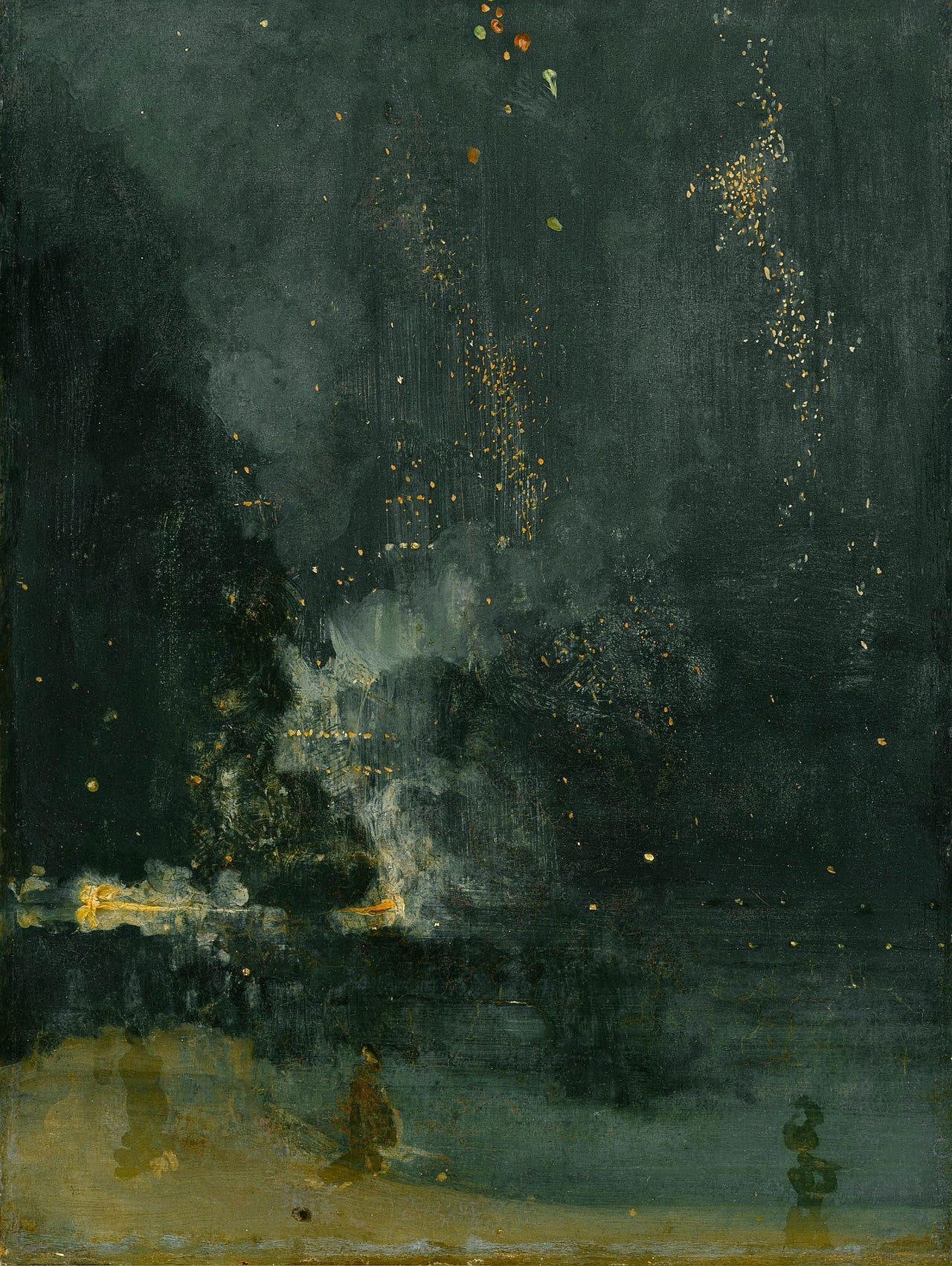
Ruskin wrote the following assessment, which became the basis for the lawsuit:
For Mr. Whistler’s own sake, no less than for the protection of the purchaser, Sir Coutts Lindsay ought not to have admitted works into the gallery in which the ill-educated conceit of the artist so nearly approached the aspect of willful imposture. I have seen, and heard, much of Cockney impudence before now; but never expected to hear a coxcomb ask two hundred guineas for flinging a pot of paint in the public’s face.
The painting that triggered this outrage, Nocturne in Black and Gold, was a radical departure from Victorian artistic norms. Rather than offering a clear narrative or a realistic depiction of a scene, the work was an atmospheric, nearly abstract representation of a fireworks display in London’s Cremorne Gardens. It featured dark, shadowy masses and flecks of yellow paint to represent sparks and light. To Ruskin, the lack of “finish” and the high price tag appeared to be a scam.
Whistler’s Motivation and Context
By 1877, Whistler was a central figure in the Aesthetic Movement, but his financial position was precarious. He was heavily in debt, largely due to the construction of his expensive new home, the “White House” in Tite Street, Chelsea. He relied on the sale of his paintings to resolve his debts.
Ruskin’s critique was not just an artistic disagreement; it was a commercial blow from the most powerful critic in Britain. Whistler sued for libel, seeking £1,000 in damages. His motivation was practical as well as philosophical: he argued that Ruskin’s accusation of “imposture” attacked his professional integrity and directly threatened his livelihood.
Key Figures and Positions During the Trial
The trial took place in November 1878. John Ruskin was unable to appear in court, having suffered a severe mental breakdown earlier that year. In February 1878, he had experienced his first major psychotic episode, which he described as “brain fever,” involving delirium and intense paranoia. Although he had periods of lucidity, his health remained fragile, and his doctors forbade him from attending the trial to avoid the stress. Consequently, he was represented by legal counsel, a factor that likely hurt his defense as the jury never heard the authoritative voice that had made him England’s leading critic.
The trial became a public debate on the definition of art, involving several prominent figures of the Victorian art world. The defense called several witnesses to support Ruskin’s critique. Edward Burne-Jones, a celebrated Pre-Raphaelite painter, served as the star witness. While admitting Whistler’s work possessed “fine color” and “atmosphere,” Burne-Jones ultimately testified that the painting was incomplete, labeling it “one of the thousand failures to paint night” and unworthy of its price. William Powell Frith, known for detailed narrative scenes like The Derby Day, also testified, arguing that Whistler’s work lacked the distinct composition and laborious detail required to be considered true art.
In his defense, Whistler called witnesses who, while sometimes lukewarm, supported his artistic integrity. William Michael Rossetti, an art critic, testified that he believed the painting was a genuine work of art by a conscientious artist. Albert Moore offered the strongest support, praising the painting’s artistic qualities and contradicting the notion that it was merely “flung” paint. Whistler himself represented his case with wit, famously engaging in a cross-examination regarding the time it took to paint the Nocturne. When asked if he demanded 200 guineas for the labor of two days, he replied with a retort later recorded in his book The Gentle Art of Making Enemies (1890): “No, I ask it for the knowledge of a lifetime.”
The Outcome
The jury reached a verdict in favor of Whistler, agreeing that Ruskin’s comments were libelous, but the victory was pyrrhic. They awarded Whistler only one farthing in damages—the smallest coin in British currency. This nominal sum indicated that while the jury agreed a technical libel had occurred, they did not believe Whistler suffered significant financial damage or that his reputation merited compensation. Furthermore, the judge, Baron Huddleston, exercised his discretion to order each party to pay their own legal costs, rather than the standard practice of the loser paying all.
The consequences were severe, particularly for Whistler. The legal fees bankrupted him, and within months he was forced to file for bankruptcy, losing his new house and art collection. He eventually left London for Venice to rebuild his career through etchings. Ruskin, though wealthy enough to bear the financial cost, was deeply humiliated. Viewing the court’s interference in art criticism as intolerable, he resigned his prestigious post as Slade Professor of Fine Art at Oxford in protest.
Impact on Art and Libel
The Whistler/Ruskin trial left a lasting legacy in two primary areas. First, it marked a decline in the absolute power of the art critic, establishing a legal precedent that while critics had wide latitude, personal attacks on an artist’s character (calling them an “impostor”) crossed a line. Second, it became a cultural battleground where modern art began to separate from Victorian tradition. Whistler’s defense—that art did not need to be realistic or finished but could be an abstract arrangement of color and mood—validated the tenets of the Aesthetic Movement and paved the way for the acceptance of abstract art in the 20th century.
Ultimately, the trial dismantled the idea that art requires a moral function or high polish to possess value.
Relevance Today
The historical record of Whistler v. Ruskin is settled, yet the trial continues to resonate as a parable for the modern age, particularly in the context of a Europe hungry for innovation yet often resistant to the mechanisms that produce it. The courtroom battle serves as a stark early example of the clash between ‘honest labor’ and ‘capitalist art.’ Ruskin represented an old-world idealism where value was intrinsic to the effort expended; Whistler embodied a modern, market-driven pragmatism where value was determined by the skill and brand of the creator, regardless of how quickly the work was produced.
This dynamic remains strikingly relevant. The suspicion that greeted Whistler’s efficiency parallels the skepticism often directed at entrepreneurialism today. In many European intellectual circles, the rapid scaling of startups and the aggressive pursuit of profit are frequently viewed with a Ruskin-esque disdain, seen as vulgar or lacking in ‘craft.’ When new ventures emerge, the conversation often shifts quickly to questioning the financial motives of the entrepreneurs and investors rather than celebrating the utility or ingenuity of the innovation.
Thus, the 1878 dispute was not merely a quarrel over aesthetics; it was a prescient manifestation of a persistent cultural divide regarding the morality of commercial ambition, a divide that continues to shape the economic landscape of the Western world.