
There is a not well-known museum on Rue de La Rochefoucauld in the 9th arrondissement of Paris, dedicated to the work and personal history of the Symbolist painter, Gustave Moreau.
Chances are that it’ll be closed when you try to go. In theory it’s open five days a week, but on many occasions, it’ll be closed due to staff strikes, safety issues with the building, solidarity with other strikers, etc. I have probably been turned away no fewer than half a dozen times from this museum, but I keep going back because what it holds is something very special.
Symbolism is rarely cited as a favorite movement. It often lacks the immediate appeal of Impressionism. But Moreau created elaborate works that go beyond the goals of contemporaries like Puvis de Chavannes or Odilon Redon. His canvases are not mere decorations. They are dense environments. You can stare at the paintings for hours. You inhabit them. You leave with the sense that you saw only a fraction of what was there.
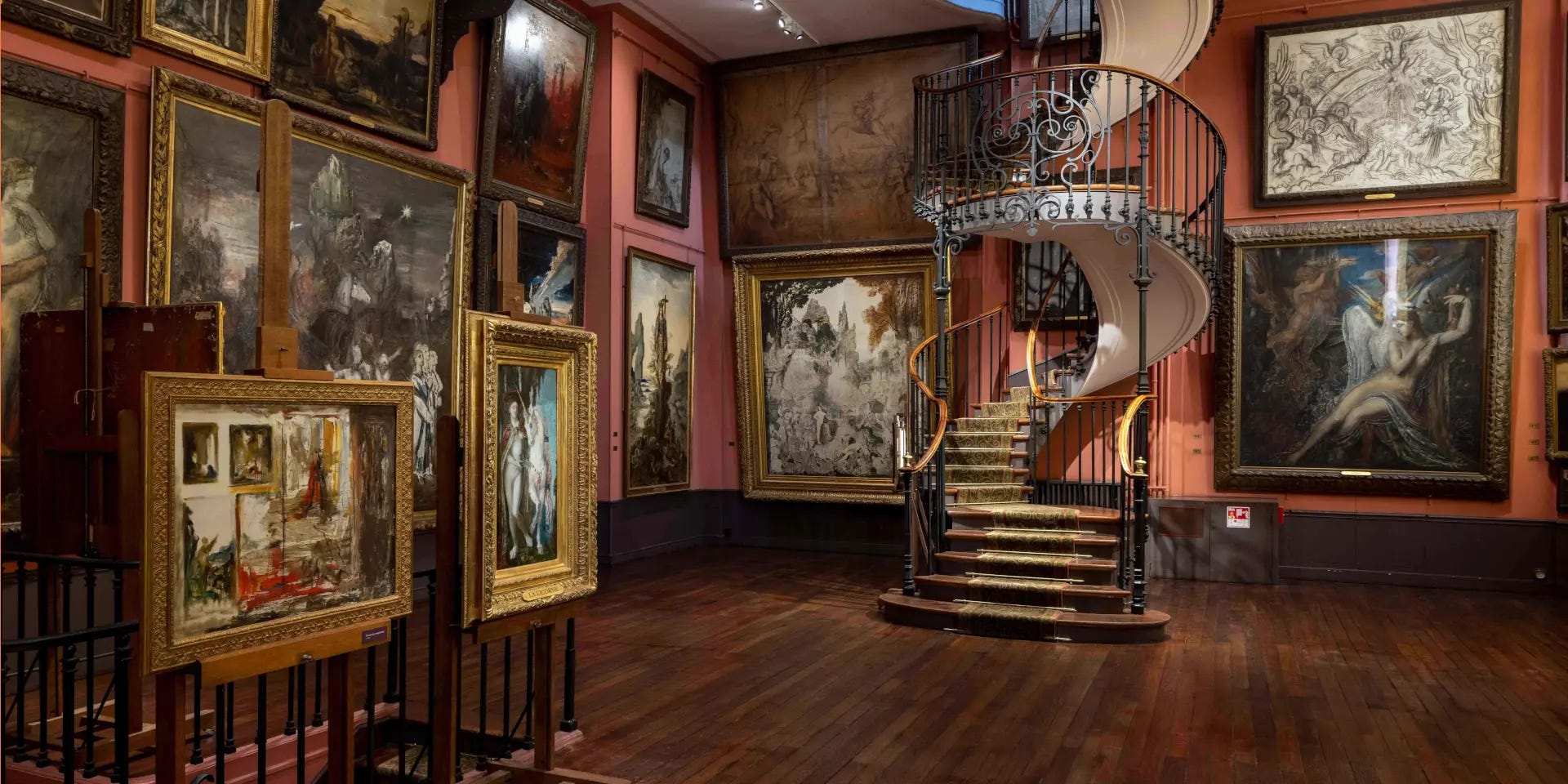
Sanctuary on Rue de La Rochefoucauld
The museum was originally the Moreau family home. In 1895, Moreau commissioned architect Albert Lafon to expand the building. The renovation combined the residential apartments on the lower floors with large exhibition studios on the second and third floors. A spiral staircase connects the upper levels.
The collection housed within these walls is extensive. There are approximately 25,000 works in total. The studio walls display roughly 1,300 paintings, watercolors, and cartoons. Additionally, nearly 5,000 drawings are accessible to visitors through a system of pivoting wooden shutters built into the walls. The rooms also contain the artist’s personal furniture and belongings, preserved in their original arrangement.
Artist and Professor
Moreau painted from the imagination. He rejected the Realism of his time. He did not paint modern life. He looked to the Bible and Greek mythology. The subjects are often poets, kings, or sphinxes. The canvases are massive. They tower over the viewer. He filled the space with architectural details and strange vegetation.
Layers of material were built up using palette knives, rags, and even his thumbs. In many of the large works, parts of the canvas remain abstract. Light was created by scraping the surface rather than painting on top. This technique resulted in a density that contrasts with the smooth finish of the academic Salon painters.
His distinct palette relied on colors that resemble jewels. The paint was applied thickly, often combined with other mediums to create texture. This independence defined his approach as a professor at the École des Beaux-Arts. Students like Henri Matisse and Georges Rouault were not asked to imitate him. Instead, the instruction focused on following their own internal color.
Static Iconography of Salome
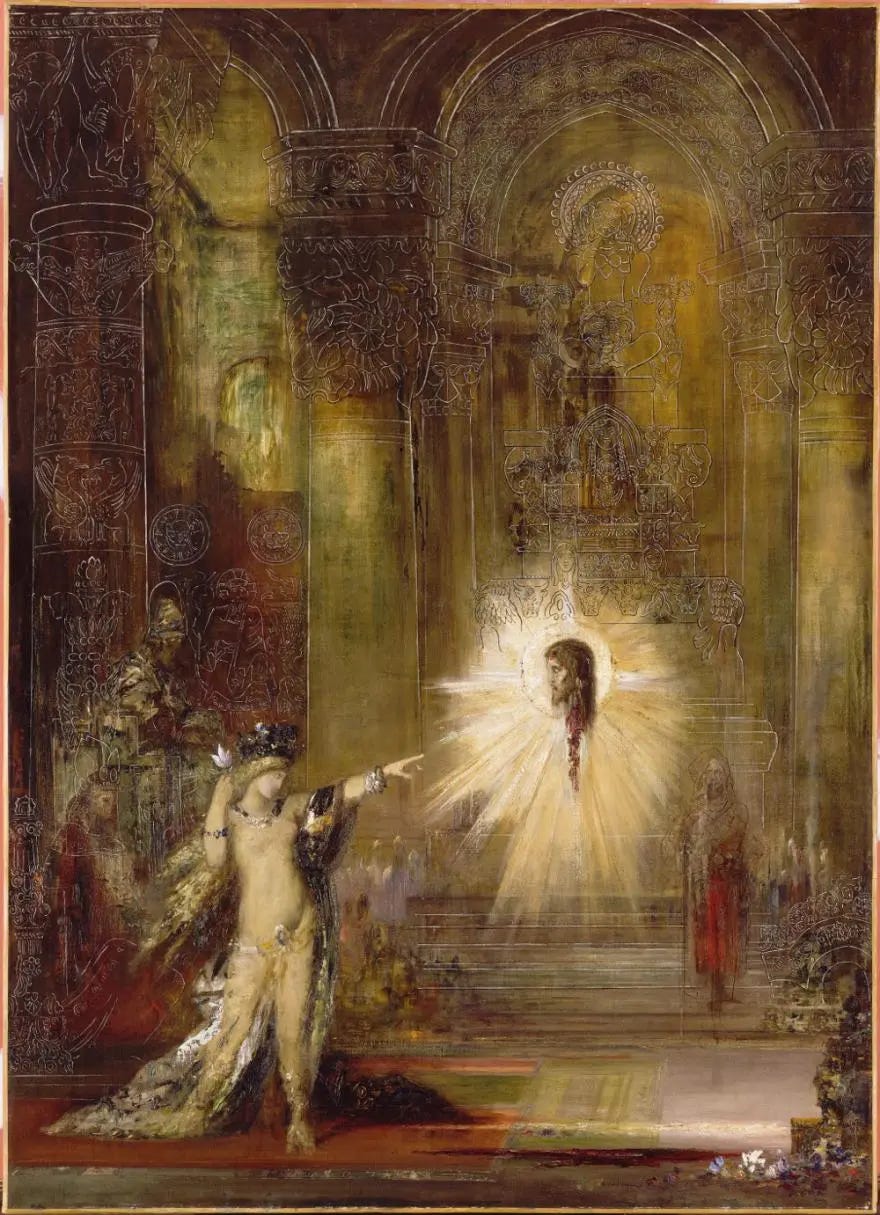
The role of the figure in Moreau’s work is one of tension and suspension. The subject of Salome appears repeatedly in his oeuvre. She stands in palaces that resemble cathedrals or Hindu temples. Moreau depicted her clad in heavy jewels and intricate textiles.
Unlike the dynamic, fleeting gestures captured by Degas, Moreau froze his subjects. In The Apparition, the figures remain locked in a gaze. The severed head of John the Baptist floats in the air while Salome points to it. The drama is psychological rather than physical. He loaded the surface with ornamentation until the atmosphere seemed to thicken. The paint itself becomes a jeweled casing that traps the figures in a moment of eternal waiting.
Influence on the Avant-Garde
The abstract quality of his unfinished backgrounds and oil sketches anticipated the direction of modern art. While he taught his students to respect the old masters, his own practice gave them permission to experiment with color and form. The wildness found in the early works of Matisse and the Fauves has its roots in the freedom Moreau allowed within his studio.
He encouraged his students to follow their own internal logic. He told them, “I am the bridge over which certain of you will pass.” His legacy is not just in the specific style of Symbolism but in the permission he gave future generations to prioritize the imagination over the eye.
Conclusion
The Gustave Moreau museum remains one of the few places where you see an artist’s work as he intended. It is a distinct alternative to the major collections in Paris. You avoid the crowds of the Musée d’Orsay and the Louvre. Here, the rooms are often empty. You hear your own footsteps on the parquet. It is a chance to study the work in depth. These paintings require time.
Watch this documentary, check your horoscope, and go! And when the museum is actually open you’ll find the staff are incredibly nice, helpful and knowledgable.