
1. The Louvre Intrusion and the Paradox of Public Scrutiny
The audacious jewel robbery at the Musée du Louvre—executed in mere minutes via a makeshift furniture lift to penetrate the sacred space of the Galerie d’Apollon—did more than just shock France; it offered the world a jarring spectacle. On October 19, 2025, thieves absconded with royal jewels valued at approximately €88 million in a swift, surgical operation (Wikipedia — 2025 Louvre robbery).
The incident instantly became a global talking point, fueling late-night monologues and a viral surge of mockery aimed at the perceived security lacunae in one of the planet’s foremost cultural institutions.
Ridicule is a fleeting gesture. Stewardship, by contrast, is a permanent commitment.
While glib commentary propagated faster than official accounts, French authorities swiftly and decisively committed to strengthening oversight, utilizing the government’s mandate to accelerate long-anticipated security modernization measures. The Louvre’s renown is not fragile; it will endure. And the Ministry of Culture, the very custodian of the national soul the Louvre represents, stands precisely where it must: at the apex of the corrective response.
2. The Architecture of Identity: A Ministry’s Immeasurable Reach
Established in 1959 by Charles de Gaulle and first entrusted to the visionary André Malraux, France’s Ministry of Culture was built on one of the most enlightened precepts of modern governance: the radical notion that culture and knowledge are universal rights, not rarefied privileges (Wikipedia — Ministry of Culture, France).
The Ministry’s remit is vast and systemic, spanning the entirety of the cultural sphere: museums, cinema, performing arts, architecture, broadcasting, archives, heritage preservation, and cultural pedagogy.
The scale of this governmental commitment can be quantified:
Key Indicators
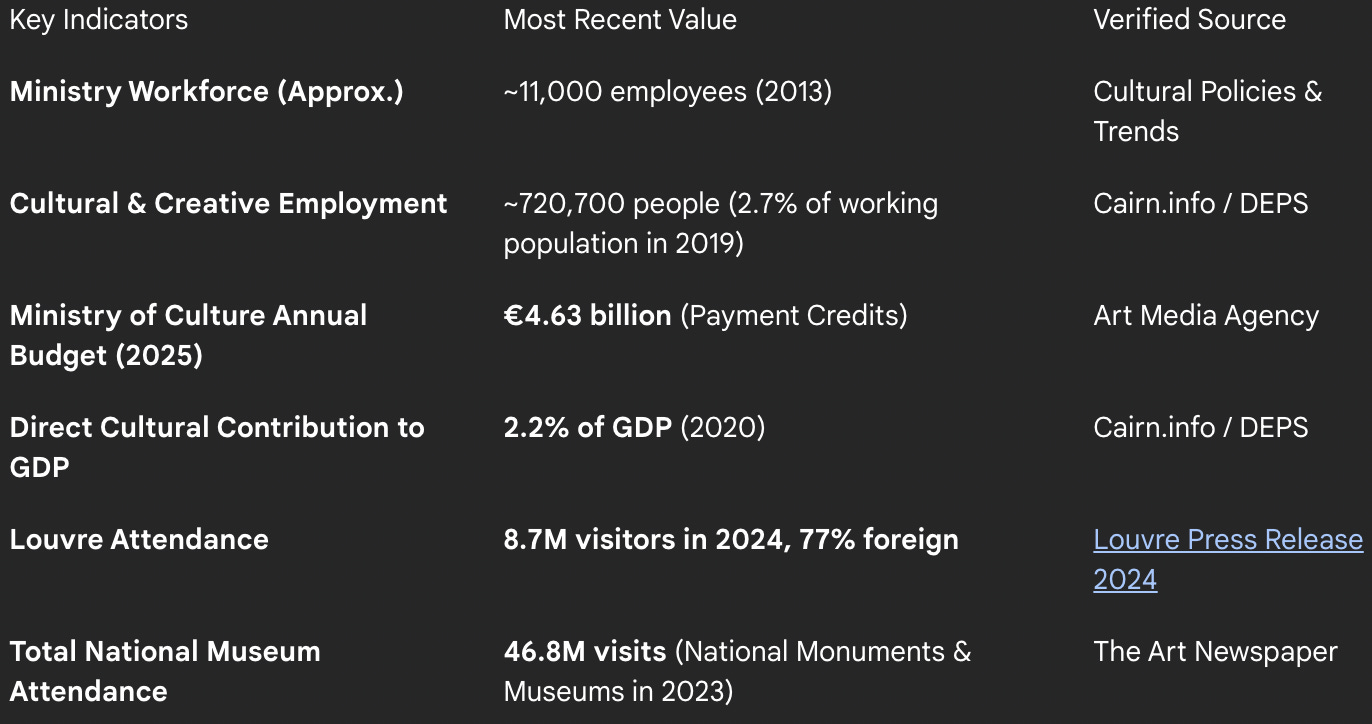
This agency is not a mere bureaucratic layer; it is an integrated ecosystem of national self-definition. Culture, for France, is not an aesthetic accessory; it is the fundamental bedrock of the French state—its ongoing narrative, its collective memory, and its most potent form of soft power.
3. Preservation as a Promise: The Intergenerational Contract
France’s cultural patrimony is immense, encompassing everything from prehistoric cave art and Romanesque basilicas to medieval ramparts and the urban revolutions of the Enlightenment. These physical foundations of culture are constantly besieged by the entropy of time.
While concerns over aging monuments and the capacity for restoration have been noted (The general sentiment of Le Monde, Sept 2024 is maintained), the Ministry has responded with evolving and sophisticated mechanisms:
Innovative funding: Creation of Loto du Patrimoine to directly fund restoration.
Patronage frameworks: Reinforcing systems for private and municipal cultural investment.
Targeted response: Coordinating swift interventions for endangered historical sites.
The state-coordinated, globally-backed restoration of Notre-Dame de Paris following the 2019 conflagration stands as the ultimate testimony to this commitment: France does not, and will not, abandon the defining symbols of its identity.
Preservation is not an act of looking backward with nostalgia. It is an act of sovereign promise to the future.
4. Cultivating Creation: Investing in the Unborn Legacy
The Ministry’s mandate extends far beyond mere conservation; it actively cultivates the genesis of new work. Contemporary creation is vitalized through a network of national theaters, arts education programs, state-funded film and media initiatives, and the unique system of regional contemporary art collections known as FRACs (Ministry FRAC overview).
Through its supervision of the CNC (National Centre for Cinema), the Ministry ensures that French filmmaking remains creatively adventurous, fiscally independent, and competitive on the global stage (CNC professional portal).
A nascent choreographer in Lille or a visionary filmmaker in Marseille is liberated from the necessity of appealing solely to private philanthropy or high-risk venture capital. Creative risk, in France, is regarded as a public investment—an extraordinarily enlightened position in a world that increasingly relegates culture to the volatile churn of the market.
5. The Singular Brand of Cultural Solidarity
Millions journey to France annually seeking an ineffable quality they instantly recognize: the experience of a civilization that treats beauty and depth with uncompromising gravity.
In contrast, global powerhouses like MoMA, the Met, or the Getty in the United States operate as fragmented, independent entities, often competing fiercely for survival within a donor-dependent and ticket-driven market. France, crucially, chose a different paradigm: cultural solidarity over cultural competition.
The Louvre, Versailles, the Pompidou, the Orsay—every national monument and regional museum shines individually, yet their collective brilliance is amplified by their unified identity under state stewardship.
The spectacle of a crime may invite temporary derision. But France’s enduring cultural leadership in the world is beyond dispute.
6. Resilience Through Reform: The Will to Improve
A system that achieves stasis is a system that invites decay. A system that embraces reform assures survival. France’s cultural apparatus has continually refined itself through public controversy and necessary institutional change:
Restitution: Reforms addressing colonial-era remains and artifacts culminated in a 2023 law, leading to the high-profile return of human skulls to Madagascar in August 2025 (TRT World, France repatriates three colonial-era skulls to Madagascar).
Accountability: Administrative clarity was sharpened following findings from the Cour des comptes (National Audit Office), notably regarding the management and scope of the popular Pass Culture scheme (Cour des comptes, First assesment of the pass Culture scheme).
Modernization: Museum security protocols have been urgently accelerated in direct response to newly exposed vulnerabilities.
The Ministry does not claim infallibility. It champions perpetual improvement. This is the core of its enduring strength.
Conclusion: Cultural Democracy in Action
France operates from the profound conviction that culture is a public entitlement—not an ornamental hobby for the elite. It believes that beauty must be accessible, not hoarded; that memory must be a shared resource, not a hidden archive; and that imagination must be publicly funded, not merely passively tolerated.
Yes, a single, spectacular act of criminality briefly rendered the Ministry vulnerable to critique. Yet, the shallow jokes of the moment will be forgotten long before the foundational monuments fade. Because France chooses to invest in the permanent, the universal, and the essence of the human condition.
Every nation has much to gain from such an institution. Few possess the civic wisdom to truly build one.